- Your cart is empty
- Continue Shopping




€70
Pregabalin 300mg capsules offer significant relief for nerve pain, seizures, and anxiety, backed by clinical evidence. However, professional guidance is essential for safe use. If you’re considering this treatment, prioritize a doctor’s consultation to explore options tailored to your health needs.
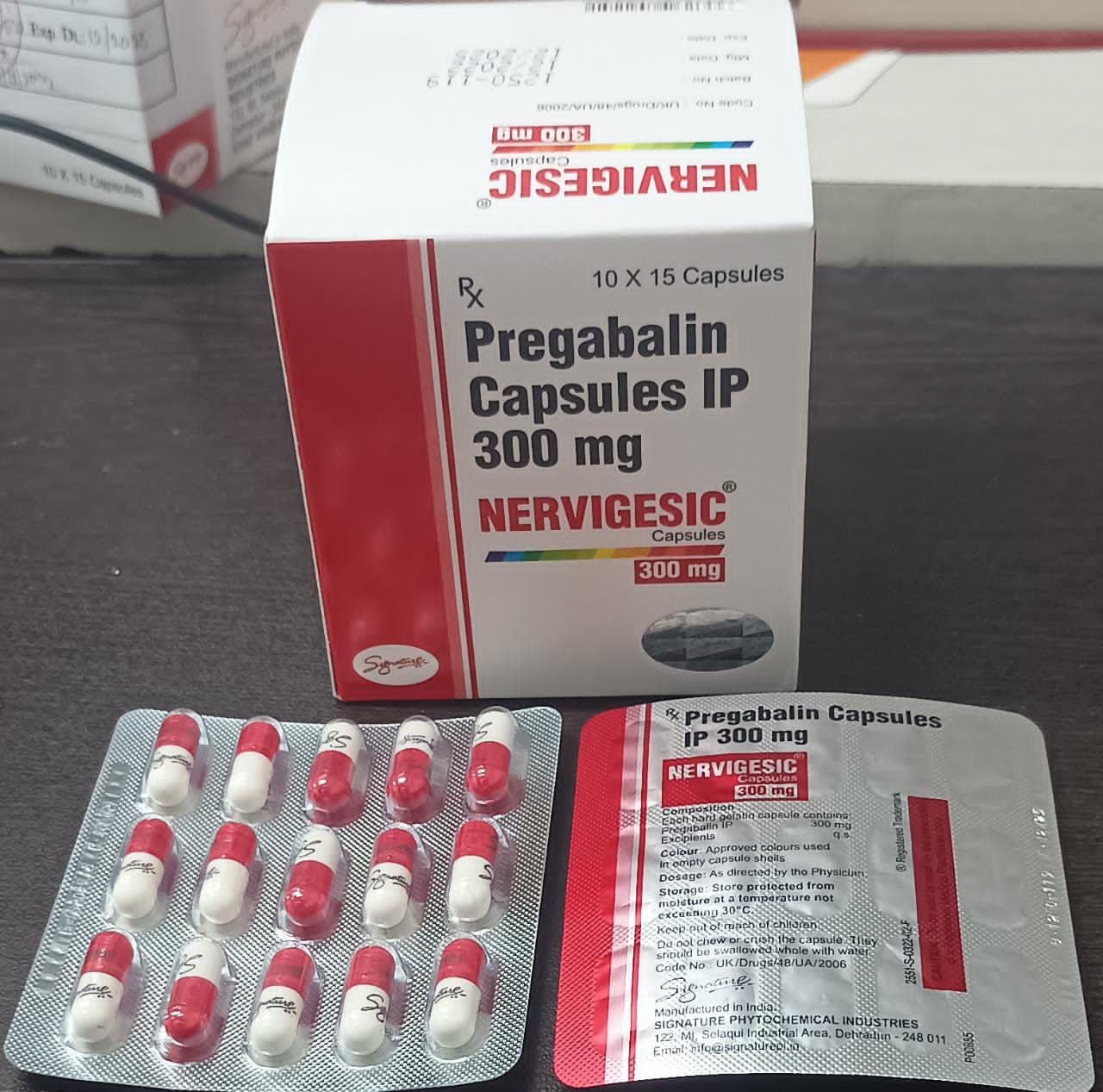
Pregabalin 300mg Capsules (commonly known by the brand name Lyrica) is a high-potency oral gabapentinoid and a Schedule V controlled substance in the United States. As the highest standard single-capsule strength manufactured, Pregabalin 300mg is indicated for the clinical management of severe neuropathic pain, fibromyalgia, postherpetic neuralgia, and as an adjunctive treatment for adult partial-onset seizures.
Neuropathic Pain: Indicated for severe peripheral neuropathy associated with diabetic nerve damage and spinal cord injury.
Postherpetic Neuralgia (PHN): Prescribed for chronic neuropathic pain following acute herpes zoster (shingles) outbreaks.
Fibromyalgia: Used to manage widespread musculoskeletal pain, sleep disturbances, and fatigue.
Adjunctive Seizure Control: Approved as an add-on therapy for adult partial-onset focal seizures.
Pregabalin is a structural analogue of $\gamma$-aminobutyric acid ($\text{GABA}$), but it does not bind directly to $\text{GABA}_\text{A}$ or $\text{GABA}_\text{B}$ receptors:
Ligand Binding: High affinity binding to the $\alpha_2\delta$ auxiliary subunit of presynaptic voltage-gated calcium channels (VGCCs) in the central nervous system.
Neurotransmitter Inhibition: Reduces calcium influx, dampening the presynaptic release of excitatory neurotransmitters including glutamate, substance P, and calcitonin gene-related peptide (CGRP).
Pharmacokinetics: Rapidly absorbed with oral bioavailability $\ge 90\%$; reaches peak plasma concentrations within 1.5 hours with an elimination half-life of 6.3 hours. It is eliminated unchanged via renal excretion.
The 300mg strength represents the maximum single unit dosage and is typically reserved for maintenance therapy after gradual titration.
| Parameter | Standard Clinical Dosing Protocol |
| Initial Titration | Started at 75mg to 150mg daily in 2 divided doses to assess patient tolerance. |
| Maintenance Dosing | Titrated to 300mg daily (150mg twice daily) within 1 week based on response. |
| Maximum Daily Limit | 600mg per day (administered as 300mg twice daily) for severe neuropathic pain or refractory seizures. |
| Renal Impairment Adjustment | Dosage must be reduced in patients with compromised renal function ($\text{CrCl} < 60\,\text{mL/min}$). |
Retail Pharmacy Pricing: Generic Pregabalin 300mg capsules average $18.00 – $30.00 for 60 capsules using retail discount cards. Out-of-pocket cash prices without discounts range from $250.00 to $300.00+.
Street Value & Harm Reduction: On the informal market, 300mg capsules command $3.00 to $8.00 per capsule. Pregabalin is sought illicitly to potentiate opioids or sedatives. Unregulated street capsules carry severe risks of containing dangerous counterfeit adulterants, such as synthetic opioids (fentanyl) or designer benzodiazepines.
Withdrawal & Dependence: Abrupt discontinuation can trigger insomnia, nausea, severe headaches, anxiety, hyperhidrosis, and rebound seizures. Taper gradually over at least 1 week.
Respiratory Depression Risk: Severe respiratory distress can occur when combined with CNS depressants, particularly opioids, or in patients with underlying respiratory impairment (e.g., COPD).
Adverse Effects: Common side effects include marked somnolence, dizziness, peripheral edema, weight gain, blurred vision, and cognitive slowing.


 English English
 German
 Italian
 Dutch
 Spanish