- Your cart is empty
- Continue Shopping


€180
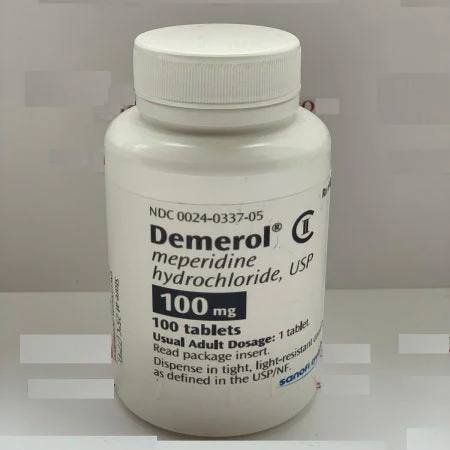
Demerol 100mg is a potent synthetic opioid analgesic containing meperidine hydrochloride (also known as pethidine). Classified as a Schedule II controlled substance, Demerol 100mg is indicated for the management of acute severe pain where alternative non-opioid treatments are inadequate or un-tolerated. Unlike long-acting maintenance opioids, meperidine is reserved primarily for short-term acute pain management and specific perioperative protocols due to the neurotoxic risks associated with its primary metabolite.
Acute Moderate-to-Severe Pain: Indicated for short-term control of acute pain episodes, such as post-surgical pain, acute obstetric pain during labor, or severe acute trauma.
Preoperative & Perioperative Sedation: Prescribed as a preoperative medication to reduce anxiety, facilitate anesthetic induction, and provide surgical analgesia.
Postoperative Rigors Management: Utilized off-label in specialized inpatient settings to suppress post-anesthetic shivering (rigors) via non-$\mu$ receptor pathways.
Demerol 100mg produces analgesia through selective interaction with central nervous system opioid receptors, alongside secondary anticholinergic and local anesthetic properties:
Central $\mu$-Opioid Agonism: Meperidine acts as a full agonist at central $\mu$-opioid receptors. Binding activates $G_i/G_o$ proteins, inhibiting adenylyl cyclase, reducing presynaptic calcium influx, and hyperpolarizing postsynaptic membranes to block pain transmission along ascending spinal pathways.
Secondary Pharmacological Actions: Exhibits mild local anesthetic properties (via sodium channel blockade) and weak anticholinergic activity, which can cause mydriasis and tachycardia rather than the typical opioid-induced miosis and bradycardia.
Pharmacokinetics & Metabolite Accumulation: Rapidly absorbed orally, achieving peak plasma concentration ($T_{\max}$) within 1 to 2 hours (half-life of $\approx 3\text{ to }5\text{ hours}$). Meperidine undergoes hepatic $N$-demethylation via $CYP2B6$ and $CYP3A4$ into normeperidine, an active metabolite with a long elimination half-life (15 to 30 hours) that exerts potent central nervous system excitation.
| Clinical Parameter | Standard Prescribing Protocol |
| Active Ingredient | Meperidine hydrochloride 100mg (Oral tablet or solution). |
| Administration Route | Administered orally with water; may be ingested with or without food. |
| Dosing Frequency | Typically prescribed as 50mg to 150mg every 3 to 4 hours as needed for short-term pain relief. |
| Duration Cap | Treatment should not exceed 48 hours, and total daily doses should not exceed 600mg to prevent normeperidine accumulation. |
Black Box Warning — Abuse, Addiction, and Misuse: Demerol 100mg carries significant risks of opioid addiction, abuse, and misuse, which can lead to severe overdose and death.
Normeperidine Neurotoxicity: Accumulation of normeperidine (especially in patients with renal impairment or continuous use $>48\text{ hours}$) can trigger CNS excitation, hyperreflexia, tremors, myoclonus, and grand mal seizures.
Monoamine Oxidase Inhibitor (MAOI) Interaction: Strictly contraindicated in patients taking MAOIs or within 14 days of stopping them; co-administration can precipitate fatal serotonin syndrome or severe hyperpyrexic crises.
Life-Threatening Respiratory Depression: Severe respiratory depression can occur; concomitant use with alcohol, benzodiazepines, or other CNS depressants carries extreme risks of coma and death.


 English English
 German
 Italian
 Dutch
 Spanish